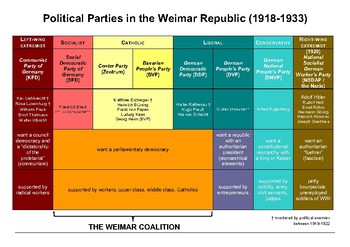
In the fourteen years the Weimar Republic was in existence, some forty parties were represented in the Reichstag. This fragmentation of political power was in part due to the use of a peculiar proportional representation electoral system that encouraged regional or small special interest parties and in part due to the many challenges facing the nascent German democracy in this period.
After the Nazi seizure of power, they used the provisions of the Reichstag Fire Decree to effectively eliminate their chief adversaries, first the Communists (March 1933) and then the Social Democrats (22 June 1933) through arrests, confiscation of assets and removal from office. Other parties were pressured into disbanding on their own or were swept away by the "Law Against the Formation of Parties" (14 July 1933) which declared the Nazi Party to be Germany's only legal political party.
Weimar political parties
Other political organizations
Besides the larger parties, there were also a multitude of smaller groups and parties that were either affiliated with the electoral coalitions of larger parties or were organizationally independent and participated with their own lists either throughout the entire Republic or only in individual constituencies.
Unions
- Allgemeiner Deutscher Gewerkschaftsbund (ADGB)
- Allgemeiner freier Angestelltenbund (AfA) white-collar employee union affiliated with the SPD-dominated free trade unions. (Pro-Weimar Republic)
- Deutscher Landarbeiterverband (German Agricultural Workers' Union) SPD-organized. (Pro-Weimar Republic)
- Deutschnationaler Handlungsgehilfenverband (DHV) (National Association of Clerical Employees) — the conservative white-collar worker union. The DHV leadership did not fully support the NSDAP because it didn't recognize the independence of unions. (Against the government)
- Freie Arbeiter-Union Deutschlands (FAUD) — an anarcho-syndicalist trade union that participated in the revolution in Germany and continued to be involved in the German labor movement in the early 1920s.
- Gesamtverband Deutscher Beamtengewerkschaften (GDB) was a conservative civil service union.
- Gewerkschaftsbund der Angestellten (GdA) was a Hirsch-Duncker union.
- Gewerkschaftsbund deutscher Angestelltenverbände (Gedag) was a conservative white-collar union.
- Reichsbund Deutscher Angestellten-Berufsverbände was a conservative white-collar union.
- Vereinigung der chrislichen-deutschen Bauernvereine (Association of Christian-German Peasant Unions)
- Zentralverband der Angestellten (ZdA), an association of white-collar unions started by the SPD. (Pro-Weimar Republic)
Other Organizations
- Alldeutscher Verband — Pan-German League. A nationalist and colonialist organization whose goal was to nurture, protect and expand German nationality as a unifying force. (Against the government)
- Deutsches Handwerk. German crafts organization headed by Zeleny. Zeleny advocated positions that would improve conditions for the old middle class. It would later back the NSDAP.
- Katholische Burschenvereine. Catholic youth associations that the Catholic Church started in southern Germany to provide Catholic youth with numerous activities.
- Tatkreis movement
- Völkisch movement (Against the government)
Secret societies
- Bund Wiking — Viking League. A paramilitary organization founded in Munich in 1923 by members of the banned Organisation Consul as a successor group. Its stated aim was the establishment of a military dictatorship and modification of the Treaty of Versailles by armed means, including provocations intended to incite workers into violence and provide the pretext for a coup.
- Organisation Consul (OC) — An ultra-nationalist and anti-Semitic terrorist organization that operated from 1920 to 1922. It was formed by Hermann Ehrhardt and several members of his Freikorps brigade. It was responsible for political assassinations, including former Minister of Finance Matthias Erzberger and Foreign Minister Walther Rathenau, that had the goal of destroying the Republic and replacing it with a right-wing dictatorship. The group was banned by the German government in 1922.
- Schwarze Reichswehr — Black Reichswehr. Extra-legal paramilitary formations promoted by the German Reichswehr to circumvent manpower restrictions imposed by the Versailles Treaty. Black Reichswehr members were responsible for several Feme murders. Active 1921 to 1923.
Reichstag election results
All vote numbers in thousands.
- Regional= Total for regional parties not listed individually
- Rightist= Total for right-wing parties not listed individually
- Splinter= Total for splinter parties not listed individually or among regional or rightist
6 June 1920
includes by-elections in Schleswig-Holstein and East Prussia (20 February 1921)
and Upper Silesia (19 November 1922)
Eligible 35,920
Turnout 28,196
% voting 78.4
(Party, Votes, Seats)
KPD 590 4
USPD 5,047 83
SPD 6,104 103
Centre 3,910 64
BVP 1,173 21
DDP 2,334 39
WP 219 4
DVP 3,919 65
DNVP 4,249 71
Regional 709 5
Splinter 161 0
Total 28,415 459
4 May 1924
Eligible 38,375
Turnout 29,282
% voting 76.3
(Party, Votes, Seats)
KPD 3,693 45
USPD 235 0
SPD 6,009 100
Centre 3,914 65
BVP 947 16
DDP 1,655 28
WP 530 10
DVP 2,728 45
DNVP 5,697 95
NSFP 1,918 32
Regional 608 5
Rightist 666 10
Splinter 682 4
Total 29,282 455
7 December 1924
Eligible 33,987
Turnout 30,290
% voting 77.7
(Party, Votes, Seats)
KPD 2,709 45
USPD 99 0
SPD 7,881 131
Centre 4,092 69
BVP 1,134 19
DDP 1,920 32
WP 639 17
DVP 3,049 51
DNVP 6,206 103
NSFB 907 14
Regional 708 4
Rightist 545 8
Splinter 401 0
Total 30,290 493
20 May 1928
Eligible 41,224
Turnout 30,754
% voting 74.6
(Party, Votes, Seats)
KPD 3,265 54
SPD 9,153 153
Centre 3,712 61
BVP 946 17
DDP 1,479 25
WP 1,388 23
DVP 2,680 45
DNVP 4,382 73
NSDAP 810 12
Regional 956 3
Rightist 1,025 23
Splinter 958 2
Total 30,754 491
14 September 1930
Eligible 42,958
Turnout 34,971
% voting 81.4
(Party, Votes, Seats)
KPD 4,592 77
SPD 8,578 143
Centre 4,128 68
BVP 1,059 19
DDP 1,322 20
WP 1,362 23
DVP 1,578 30
DNVP 2,458 41
NSDAP 6,383 107
Regional 683 3
Rightist 2,373 46
Splinter 455 0
Total 34,971 577
31 July 1932
Eligible 44,211
Turnout 36,882
% voting 83.4
(Party, Votes, Seats)
KPD 5,283 89
SPD 7,960 133
Centre 4,589 75
BVP 1,193 22
DDP 372 4
WP 147 2
DVP 136 7
DNVP 2,177 37
NSDAP 13,769 230
Regional 219 0
Rightist 552 9
Splinter 185 0
Total 36,582 608
6 November 1932
Eligible 44,374
Turnout 35,471
% voting 79.9
(Party, Votes, Seats)
KPD 5,980 100
SPD 7,248 121
Centre 4,230 70
BVP 1,095 20
DDP 336 2
WP 110 1
DVP 661 11
DNVP 2,959 52
NSDAP 11,737 196
Regional 353 1
Rightist 510 10
Splinter 252 0
Total 35,471 584
5 March 1933
Eligible 44,665
Turnout 39,343
% voting 88.1
(Party, Votes, Seats)
KPD 4,848 81
SPD 7,181 120
Centre 4,425 74
BVP 1,074 18
DDP 334 5
DVP 432 2
DNVP 3,137 52
NSDAP 17,277 288
Regional 1,246 0
Rightist 384 7
Splinter 5 0
Total 39,343 647
List by abbreviation
See also
- Weimar paramilitary groups
- Weimar Republic
- Glossary of the Weimar Republic
- Glossary of the Third Reich
- Weimar Timeline
References
Sources
- Brustein, William (1996). The Logic of Evil: The Social Origins of the Nazi Party, 1925–1933. New Haven, CT: Yale University Press. ISBN 978-0-300-06533-6.
- Mitcham, Samuel W. (1996). Why Hitler, The Genesis of the Nazi Reich. Westport, CT: Praeger. p. 72. ISBN 978-0-274-65916-6.
- Zentner, Christian; Bedürftig, Friedemann, eds. (1997) [1991]. The Encyclopedia of the Third Reich. New York: Da Capo Press. ISBN 978-0-306-80793-0.
Further reading
- Halperin, S. William (1946). Germany Tried Democracy: A Political History of the Reich from 1918 to 1933 online.
- Parteien in der Weimarer Republik Vielparteiensystem Weimarer Republik 1918/19-1933 (in German)
:strip_icc()/pic8157337.jpg)